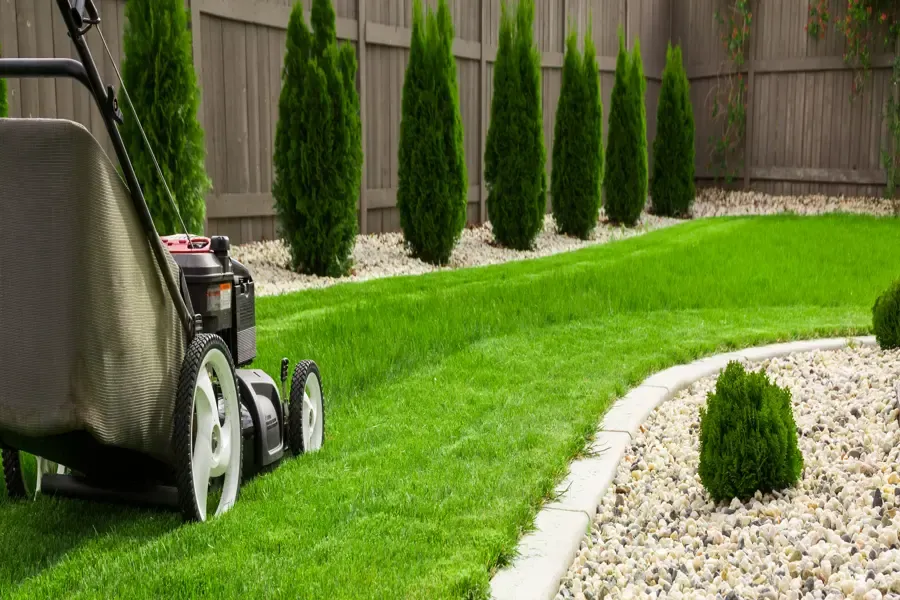
North Idaho landscaping guide and educational resource featuring seasonal timing context supporting stronger maintenance habits in Post Falls, Coeur d'Alene, and North Idaho
July – August · Peak Summer Care

Watch turf for dry patches indicating irrigation head failure

A brown arc or ring in an otherwise irrigated lawn is almost always an irrigation problem — not a disease. The faster you find and fix the failed head, the faster the turf recovers.

Why This Matters in North Idaho

Idaho summer heat means a failed irrigation head browns out turf in 5–7 days — sometimes faster. By the time a homeowner notices, recovery may take several weeks. Fast diagnosis saves turf.

Step-by-Step

  1. 1

    Run the affected zone and watch

    Run the zone in question manually and walk it immediately. A failed head is obvious: it won't pop up, sprays weakly, rotates erratically, or sprays in the wrong direction.

  2. 2

    Check for common failure modes

    Stuck head (debris in riser): attempt to rotate manually while running. Broken head: visible crack or missing top. Clogged nozzle: head pops but output is weak or off-pattern. Tilted head: physical impact from mowing.

  3. 3

    Mark failed heads with flags

    Mark every failed head before turning off the zone. Heads are impossible to find once the zone is off and they retract.

  4. 4

    Replace vs. repair

    Pop-up spray heads are inexpensive ($3–8 each) and replacement is usually faster than repair. Rotor heads ($10–25) are worth cleaning before replacement. Turn off the zone before swapping heads.

  5. 5

    Re-run and verify

    After replacement, run the zone again and walk the full arc to confirm the replacement head covers its intended throw radius without gaps or overlap.

Pro Tips from 20 Years in the Field
  • A consistently mowing-damaged head location means the head needs to be raised (riser extension) or the mowing pattern needs adjustment.
  • Wear old clothes — irrigation work gets you wet. Work in morning before the system runs on its scheduled cycle.
  • If you find a zone that's losing pressure across multiple heads (weak flow everywhere), the issue is upstream — check the valve, the mainline connection, and the backflow preventer.

When to Call LandscapePros

Our irrigation crews diagnose and repair irrigation failures efficiently. We carry common head replacements on the truck and can usually complete a repair in a single visit.

Family-Owned Since 2005

Let us handle the whole calendar.

From spring cleanup to winter dormancy — we know what North Idaho landscapes need, season by season.

July – August

Watch turf for dry patches indicating irrigation head failure: Questions We Get Asked

Idaho summer heat means a failed irrigation head browns out turf in 5–7 days — sometimes faster. By the time a homeowner notices, recovery may take several weeks. Fast diagnosis saves turf.

Get Seasonal Tips
What causes dry patches in an otherwise healthy lawn?
A failed head or a cracked lateral line. If the brown patch is round or arc-shaped, it is a head — either not popping up, blocked by debris, broken at the riser, or spray heads that have swapped nozzles. An irregular wet-dry pattern with no head nearby points to a buried lateral leak, which wastes far more water than you realize.
How do I find a broken head quickly?
Run the zone and walk it. Listen and look for heads that do not pop, spray weakly, or spray in a direction that misses the bed. A weak spray is often a partially blocked nozzle or a head that is being pushed over by mower strikes. If the zone runs at full pressure but a section stays dry, it is a line break, not a head.
Can I repair an irrigation head myself?
Yes, and it is one of the simplest landscape repairs. Turn the zone on, locate the head, unscrew the broken one, match the replacement for pop-up height, arc, and spray pattern, and hand-tighten it. Bring two spares to the site because the second one is usually wrong too. For rotor heads, match the brand and model exactly.
Why does a zone have low pressure at the far end?
Either the lateral is undersized for its run length, or the head at the end is partially blocked. A zone that flows fine at the valve but weak at the end needs larger pipe or a shorter run. This is why zone design matters — a 1,000-square-foot zone on 1/2-inch pipe will always fail at the end, regardless of pump capacity.
Coeur d'Alene Post Falls Hayden Rathdrum Spirit Lake Dalton Gardens Athol Moscow Genesee Troy Potlatch Deary Sandpoint Ponderay Priest River Dover Kootenai Kellogg Pinehurst Osburn Wallace Smelterville St. Maries Plummer Coeur d'Alene Post Falls Hayden Rathdrum Spirit Lake Dalton Gardens Athol Moscow Genesee Troy Potlatch Deary Sandpoint Ponderay Priest River Dover Kootenai Kellogg Pinehurst Osburn Wallace Smelterville St. Maries Plummer Coeur d'Alene Post Falls Hayden Rathdrum Spirit Lake Dalton Gardens Athol Moscow Genesee Troy Potlatch Deary Sandpoint Ponderay Priest River Dover Kootenai Kellogg Pinehurst Osburn Wallace Smelterville St. Maries Plummer Coeur d'Alene Post Falls Hayden Rathdrum Spirit Lake Dalton Gardens Athol Moscow Genesee Troy Potlatch Deary Sandpoint Ponderay Priest River Dover Kootenai Kellogg Pinehurst Osburn Wallace Smelterville St. Maries Plummer
Call Now Book Free Estimate